
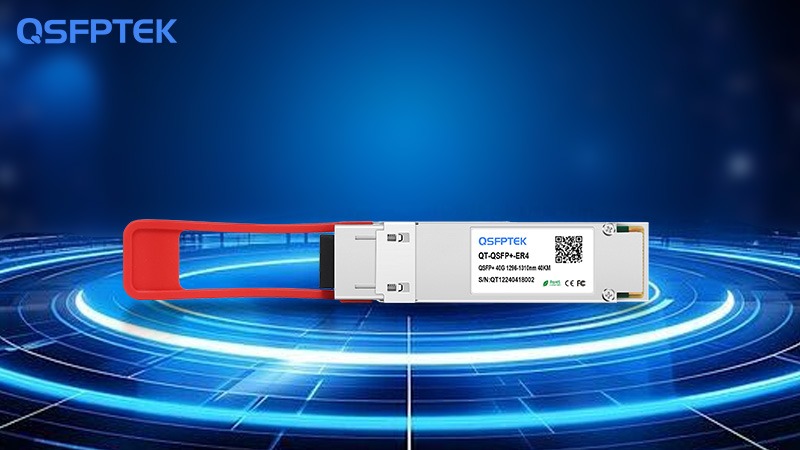
As enterprise networks, data centers, and service provider infrastructures continue to expand across wider geographic areas, the need for reliable long-haul optical connectivity remains critical. While higher-speed technologies such as 100G and 400G Ethernet are increasingly adopted, 40G networks are still widely deployed and play an important role in many long-distance applications. The QSFP+ 40GBASE-ER4 optical transceiver module, operating at 1310 nm over single-mode fiber with a reach of up to 40 kilometers, provides a mature and proven solution for long-haul 40G links. By combining wavelength-division multiplexing, stable optical performance, and digital diagnostic monitoring, ER4 modules enable network architects to optimize link reliability, performance, and operational efficiency across extended distances.
Understanding Long-Haul 40G Link Requirements
Bandwidth and Distance Considerations
Long-haul 40G links are commonly used in scenarios such as data center interconnects, enterprise campus backbones, and metro-area networks where distances exceed the limits of short-reach or standard long-reach modules. In these environments, maintaining consistent bandwidth over tens of kilometers is just as important as achieving raw transmission speed. The QSFP+ ER4 module addresses this challenge by transmitting four 10 Gbps lanes over four coarse wavelength-division multiplexing (CWDM) wavelengths within the 1310 nm window. This approach allows 40G data to be carried efficiently over single-mode fiber while minimizing dispersion and signal degradation, ensuring stable throughput even across extended fiber runs.
Reliability in Extended Fiber Links
Reliability becomes increasingly critical as transmission distances grow. Over long-haul links, factors such as fiber attenuation, connector loss, temperature variation, and environmental stress can significantly affect signal quality. QSFP+ ER4 modules are designed with higher optical power budgets to accommodate these challenges, enabling reliable transmission up to 40 kilometers without the need for optical amplification in most cases. This capability makes ER4 modules particularly well suited for deployments where simplicity and stability are prioritized, such as enterprise or service provider networks that require long-term, low-maintenance operation.
Architectural Advantages of QSFP+ ER4 Modules
Efficient Use of Single-Mode Fiber Infrastructure
One of the key advantages of QSFP+ ER4 modules is their ability to leverage existing single-mode fiber infrastructure. Many organizations already have extensive SMF deployments in metro or campus environments, and ER4 modules allow these fibers to be reused for high-speed 40G connectivity without additional cabling investment. The LC duplex interface further simplifies deployment by aligning with standard fiber patch panels and connectors, reducing complexity during installation and upgrades. By maximizing the value of existing fiber assets, ER4 modules help organizations optimize both performance and cost efficiency in long-haul network designs.
CWDM Technology and Signal Stability
The use of CWDM technology is central to the performance of ER4 modules in long-distance applications. By transmitting multiple wavelengths over a single pair of fibers, ER4 modules reduce the number of fibers required while maintaining high data rates. This wavelength separation also helps mitigate the effects of chromatic dispersion, which becomes more pronounced over longer distances. As a result, QSFP+ ER4 modules deliver consistent signal quality and low error rates, even in demanding long-haul environments where signal integrity is critical to overall network performance.
Deployment Optimization Strategies
Link Budget Planning and Validation
Optimizing long-haul 40G links begins with careful link budget planning. QSFP+ ER4 modules offer a generous optical power budget that accommodates fiber attenuation, connector losses, and system margins over distances up to 40 kilometers. During deployment, validating the link budget ensures that the transmitted signal remains within the acceptable operating range of the receiver. Proper planning not only prevents signal degradation but also provides headroom for future changes, such as additional patch panels or minor fiber rerouting, without compromising link stability.
Leveraging Digital Diagnostic Monitoring
Digital diagnostic monitoring (DDM) plays a crucial role in maintaining long-haul 40G link performance. QSFP+ ER4 modules provide real-time visibility into key parameters such as optical transmit power, receive power, temperature, and voltage. In real-world deployments, this information enables network operators to proactively detect potential issues, such as gradual signal loss caused by fiber aging or connector contamination. By leveraging DDM data, operators can address problems before they escalate into service disruptions, thereby improving overall network reliability and reducing operational risk.
Real-World Use Cases and Operational Benefits
Data Center Interconnect and Metro Networks
In data center interconnect scenarios, QSFP+ ER4 modules are frequently used to link facilities located several kilometers apart. These links support critical functions such as data replication, backup, and workload mobility. The ability to maintain stable 40G connectivity over long distances ensures that applications remain responsive and data remains synchronized across sites. Similarly, in metro-area networks, ER4 modules enable high-capacity aggregation links between access and core nodes, supporting growing traffic demands without introducing excessive complexity into the network architecture.
Long-Term Stability and Lifecycle Value
Beyond immediate performance, QSFP+ ER4 modules offer long-term value by providing a stable and well-understood technology platform. Their widespread adoption and mature ecosystem ensure broad compatibility with networking equipment from multiple vendors. This stability reduces the risks associated with long-haul deployments, where hardware replacement and troubleshooting can be costly and time-consuming. By choosing ER4 modules for 40G long-haul links, organizations benefit from predictable performance, simplified maintenance, and a longer operational lifecycle.
Conclusion
Optimizing long-haul 40G links requires a careful balance of performance, reliability, and operational efficiency. QSFP+ 40GBASE-ER4 modules deliver this balance by combining CWDM-based transmission, high optical power budgets, and comprehensive monitoring capabilities within a compact and standardized form factor. Their ability to support 40-kilometer single-mode fiber links makes them an ideal choice for data center interconnects, enterprise backbones, and metro networks where stable long-distance connectivity is essential. By leveraging existing fiber infrastructure, planning robust link budgets, and utilizing DDM for proactive monitoring, organizations can maximize the value and performance of their long-haul 40G deployments. Even as higher-speed technologies continue to emerge, QSFP+ ER4 modules remain a reliable and practical solution for optimizing long-distance 40G network links.