
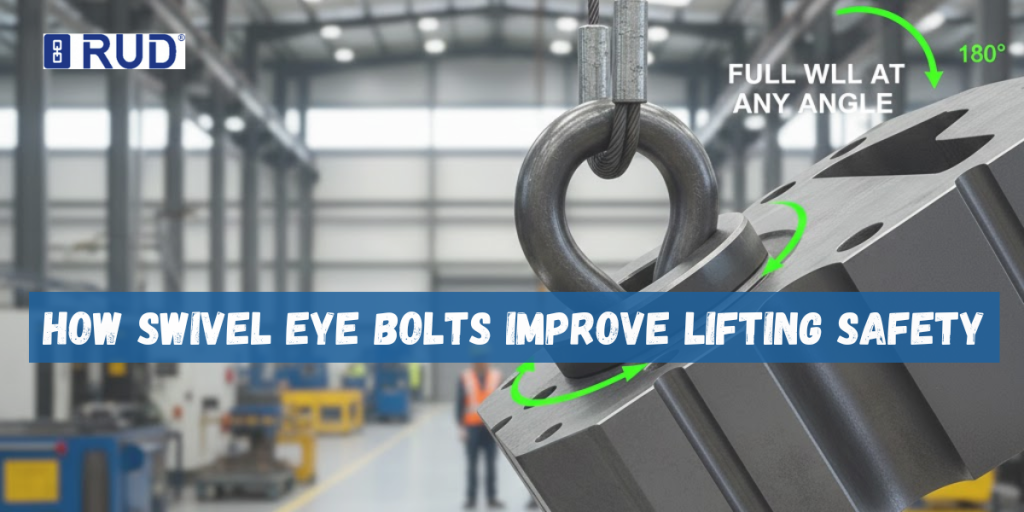
Swivel eye bolts improve lifting safety by preventing side-loading failures. And that safety comes from their ability to rotate under load, allowing the ring to follow the movement and keeping the threaded shaft stress-free.
In fact, this flexibility becomes particularly significant when you’re rigging equipment in tight spaces or operating cranes. A fixed eye bolt struggles during angled lifts because it twists against its threads and loses proper loading.
At rud.com.au, we’ve seen how this eye bolt causes equipment damage and injuries. That’s why we are writing this guide to help Australian operators understand:
- How rotating load rings work
- Which alloy steel grades provide the best durability
- How to select the right size for different lifting tasks
So, let’s start with the difference between eye bolts.
What Makes a Swivel Eye Bolt Different from Standard Eye Bolts?
A swivel eye bolt features a rotating load ring that pivots independently from the threaded shaft. Meanwhile, fixed eye bolts keep the entire assembly stationary during lifts, which creates problems when the load direction changes.
Let’s take a closer look at the details that set the swivel design apart.
Load Ring Design and Rotation Benefits
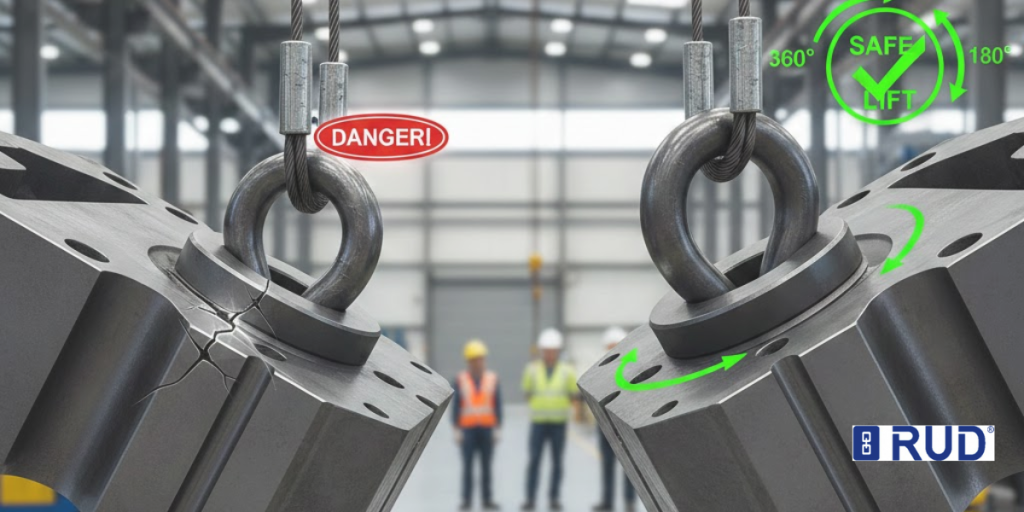
The rotating swivel ring sits on a bearing surface that lets the eye bolt pivot without twisting the threaded shaft. That’s how, when loads shift during crane travel or multi-point rigging, the ring rotates to follow the new direction.
But frankly, side loading destroys fixed eye bolts faster because its lateral force bends the shaft and strips threads from the base metal.
This way, a swivel eye bolt’s rotation handles those angular loads much better without transferring stress to the threaded connection. So, you get a longer product life with fewer replacement orders.
Alloy Steel Construction Standards
Most swivel eye bolts use high-grade forged alloy steel for the shaft and ring. Because this material composition directly affects working load limits. And it’s proven that steel with higher tensile strength ratings (like alloy steel) can handle heavier lifting tasks before reaching failure points.
Australian suppliers stock manufactured eye bolts that meet AS 3776 standards for industrial operations. This certification confirms the product has been tested under load and meets minimum safety factors.
Pro tip: When you buy a bolt, ensure the working load limit is stamped on the bolt itself because counterfeit products often skip this marking and fail basic safety checks.
Common Swivel Eye Bolt Types (M12, M16, M20)
Different-sized swivel eye bolts handle different load ranges (and yes, we’ve all grabbed the wrong size from the toolbox at least once).
Here are the types of common swivel eye bolts with their corresponding necessity:
- M12 Swivel Eye Bolts: Lighter workshop tasks where loads stay under one tonne. The smaller size makes them easy to add to jigs and fixtures without drilling large holes in the base metal.
- M16 and M20 Sizes: Heavier industrial rigging in manufacturing facilities. Port of Brisbane operations commonly use M20 swivel eye bolts for container handling equipment where loads exceed five tonnes.
- Swivel Eye Bolt Snap Designs: Some brands offer spring-loaded pins for quick attachment to lifting points without threading.
So, choosing the right size keeps your lift safe and your gear working the way it should.
Swivel Eye Bolt Applications: When Lifting Points Need Flexibility
Lifting points need flexibility because loads rarely stay perfectly vertical during operations. And this ability to rotate prevents dangerous side loading that can snap fixed eye bolts under stress.
There are some common situations where swivel designs outperform fixed options.
Rigging Scenarios Where Swivel Eye Bolts Reduce Load Stress
Generally, standard eye bolts cause problems when the load shifts direction, because the threaded shaft cannot take sideways force without bending or failing.
This problem becomes more obvious in overhead crane work, where your hook starts from the centre but gradually shifts sideways during travel. In that situation, a swivel ring can easily follow that movement, which keeps stress off the bolt threads.
The same idea applies if you have multi-point lifts. When its four eye bolts support a large machine, each point takes a different angle, and those angles change as the load rises. Here’s where a swivel ring helps by adjusting to these angles so the lift stays controlled.
We’ve seen that the need for angle-adjusting hardware (like a swivel eye bolt) becomes even more significant with rotating machinery installations. Because some loads need to turn mid-lift, such as swinging a unit 45 degrees to clear a doorway. At this point, we suggest a swivel bolt that allows the rigging to follow the rotation safely.
Heavy Duty vs Standard Swivel Eye Bolts for Lifting
Based on our work with Brisbane fabrication shops, the difference between heavy-duty and standard swivel eye bolts is mainly in their construction and capacity.
Let’s understand them in detail from the following table:
| Feature | Standard Swivel Eye Bolt | Heavy Duty Swivel Eye Bolt |
| Shaft thickness | Standard diameter | Thicker reinforced shaft |
| Load ring size | Standard | Larger forged ring |
| Typical capacity | Under 3 tonnes | 10+ tonnes |
| Best for | Maintenance lifts | Port operations, heavy industry |
Verdict: The standard versions work fine for routine workshop tasks. Meanwhile, Port of Brisbane operations specify heavy-duty variants for container handling where loads shift constantly.
Eye Bolts and Eye Nuts: Selecting the Right Lifting Point Hardware
Pick the wrong lifting point hardware, and you’re looking at failed lifts, damaged equipment, or worse (injuries on site). And you make this mistake because eye bolts and eye nuts serve different purposes in rigging setups.
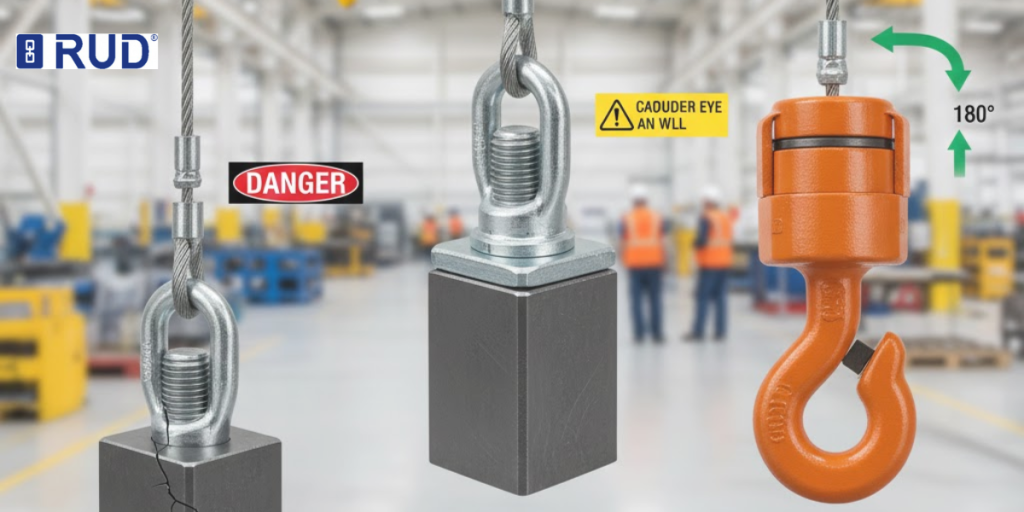
To choose the right hardware, you need to understand which standards apply to swivel eye bolts.
Swivel Eye Bolt Standards You Should Know (Australian Context)
AS 3776 covers general requirements for eyebolts used in lifting operations nationwide. So, when you buy a bolt, ensure working load limits appear on the bolt body or in accompanying documentation. Certified products at least meet minimum safety factors and material grades.
Our testing has shown that inspection intervals depend on usage frequency and site conditions. For example, a swivel eye bolt you use daily needs monthly checks. Instead, occasional maintenance work might only need quarterly inspections.
And we suggest running your inspection in three steps:
- Check the threads for wear grooves
- Examine the load ring for any oval shape or deformation
- Look closely at weld points where cracks usually start in the forged alloy steel
Quick tip: Your Brisbane sites near saltwater need a fourth check for rust pitting, because corrosion weakens metal faster than inland areas experience.
Installation Tips: How to Properly Thread and Secure Eye Bolts
Thread engagement needs to meet the minimum depth to stop the bolt from pulling out under load. For this reason, most manufacturers expect full engagement, which means threading the bolt in until the shoulder sits flat against the base metal.
Believe it or not, more failures come from improper installation than from exceeding load ratings (and we’ve seen plenty of stripped threads from overtightening). That’s why you should never force eye bolts into undersized holes or strip the threads.
Besides, apply correct torque using calibrated tools rather than just guessing by feel. And don’t forget to filter your product selection based on the type (fixed or removable) of accessory you need. Because these category affects both price and results.
Getting Your Swivel Eye Bolt Setup Right
Swivel eye bolt selection plays a major role in lifting safety across Australian worksites. Without this, many crews still run into problems because they’re unsure how swivel rings manage side loading or which steel grades match their lifting needs.
Now, you know how the ring moves, what the standards cover, and which bolt suits the load. With this knowledge, you can pick lifting points that hold up under real conditions and keep your site running safely.
Ready to stock quality swivel eye bolts? RUD Australia manufactures certified lifting hardware with proper load documentation and Australian compliance. So, contact us to find the right product for your operation and keep your team safe on site.